Jack's Tribe Hunts Ralph and Sets the Island Ablaze
Lord of the FliesJack’s Tribe Hunts Ralph and Sets the Island Ablaze turns the boys’ divided society into an organized manhunt. Ralph, once elected chief under the authority of The conch, is now the quarry of Jack Merridew’s tribe. The pursuit is meant to kill him, but its method—setting The island alight—produces the smoke that brings rescue. The hunters’ attempt to erase Ralph instead exposes their violence to the outside world and ends their isolation.
The Hunt Is Announced
After Piggy’s death and the destruction of The conch, Ralph has no remaining place in the tribe’s new order. He reaches Sam and Eric at Castle Rock, where their allegiance to Jack Merridew is no longer voluntary. They tell him that they were made to join the tribe and hurt when they resisted. Their warning is explicit: Jack Merridew and Roger hate Ralph and plan to hunt him the next day, spreading a line of searchers across The island and signaling to one another with a call. The twins also explain that the hunters are to throw their spears as if Ralph were a pig.
Ralph’s response—asking what he has done—exposes the gulf between his purpose and the tribe’s judgment. He had wanted the boys to keep a fire burning so they could be rescued; now the effort to maintain order has made him an enemy to be tracked and killed. Sam and Eric cannot promise to help him. They urge him to go, explaining that the tribe forced them into obedience and warning him particularly about Roger. As someone approaches to check on them, Ralph has to leave without persuading the twins to escape with him.
A Search Across The Island
Ralph hides in a thicket and waits for the line of hunters to pass. The searchers’ calls travel from the seashore across the narrow end of The island, making the hunt audible even when the hunters themselves remain out of sight. Ralph discovers an unexpected refuge: the great rock that killed Piggy has bounded into the thicket, breaking open a space among the stems. From inside, he hears Jack Merridew and Roger question one of the twins about where he has hidden. The twin’s pain confirms that the hunters are willing to use force to get information.
The tribe first tries to dislodge Ralph by moving another rock. The effort shakes the ground and smashes through the thicket, but Ralph survives. When the searchers’ calls resume, they change tactics. Smoke begins to seep through the branches, then thickens until Ralph has to crawl out. At the edge of the thicket he encounters a painted boy with a spear, coughing and trying to see through the smoke. Ralph attacks him with his own spear and runs into the undergrowth. The chase is not a single charge but a coordinated sweep: the hunters’ cries signal where the line is advancing and help keep it moving across the island.
From Concealment to Flight
Ralph has little time to choose a strategy. A tree might leave him trapped if the hunters spot him; breaking through the line could send him back into the same pursuit; hiding might let the searchers pass, but only if they fail to find him. With no Piggy to reason things through with and no assembly in which to deliberate, Ralph has to make each decision under pressure. His earlier ideas of escape narrow to the immediate calculations of a hunted animal: where to hide, when to run, and how to keep the searchers from closing around him.
He finds shelter beneath a dense mat of bushes and creepers, lying in darkness as the sounds of the hunt and the fire draw closer. The blaze is not incidental to the search. The hunters use it to force him out of cover, and its scale threatens even the resources they will need afterward. As the smoke dims the light above him, Ralph realizes that the fire is approaching the fruit trees. He also sees that the hunters have prepared a stake sharpened at both ends, a detail that makes the threat of capture seem more terrible than an ordinary beating or killing. While he waits, the fire’s crackling and the searchers’ cries close in together.
When a painted hunter peers into the thicket, Ralph’s hiding place is finished. He screams, bursts into the open, and knocks the hunter down with his stake. More hunters are already coming, and he runs rather than trying to hold his ground. The fire races beside the pursuit, turning the surrounding forest into a wall of heat and flame. Ralph forgets his wounds, hunger, and thirst as he runs toward The beach. The tribe’s cries rise behind him, while shelters catch fire and the blaze spreads through the landscape.
The Blaze Brings Rescue
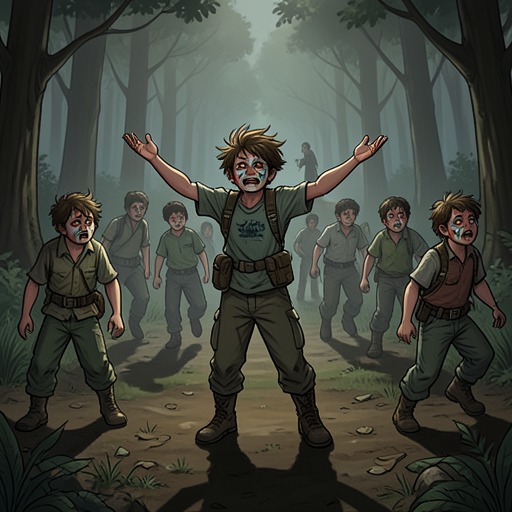
Ralph stumbles out of the burning forest and falls onto the sand, expecting the hunters to finish the pursuit. Instead, a naval officer is standing over him. A cutter has come ashore, with ratings aboard, and the officer has a revolver at his side. The hunters’ ululation falters and stops. On The beach, the boys stand in a semicircle, painted and armed with sharp sticks, suddenly silent before an adult authority.
The officer asks whether there are any grown-ups with the boys, and Ralph can only shake his head. He has arrived looking like a pursued, filthy child, while the burning island behind him makes the crisis visible. The officer says they saw the smoke and asks what the boys have been doing. Ralph acknowledges that they have been having something like a war. The signal produced by the hunt has done what the boys’ earlier effort at rescue failed to accomplish: it has drawn a ship to them.
Reversal and Significance
The ending reverses the hunt’s intended outcome. Jack Merridew’s tribe wants to flush Ralph into the open and kill him; by setting fires to find him, the hunters create a signal that brings help. Rescue comes not through the organized, carefully maintained fire Ralph had advocated, but through a destructive blaze that engulfs The island. The contrast makes the fire’s double meaning concrete: it can be a means of hope when tended as a signal, and a weapon of pursuit when turned against a human target.
The episode also brings the collapse of the boys’ shared rules to its furthest point. Earlier, Ralph had tried to hold the group together through assemblies and The conch; after Piggy’s death and the shell’s destruction, the tribe’s collective action is organized around tracking a single boy. Calls, spears, paint, and fire replace debate as the tools of authority. Yet the arrival of the Royal Navy officer interrupts that order from outside. The boys are not rescued because their society has restored its principles, but because its violence has become visible enough to summon an adult presence.